What's New in Ashby
An exclusive first look at Ashby's newest features with live demos from the product team — covering AI Talent Rediscovery and Custom Agents.
Speakers


## Key Takeaways
- AI Talent Rediscovery lets teams start every new role with a warm set of candidates already in their ATS — before they even open a sourcing tool. The criteria are the search query: what you define as 'good' becomes the engine that surfaces matching past candidates.
- Rediscovery is built on the same criteria foundation as AI-assisted application review. If you've defined criteria once, enabling rediscovery is a single toggle — and that investment compounds across every future role.
- Use the High Fit bucket during kickoff calls with hiring managers to calibrate instantly against real candidates rather than abstract criteria. Use Review Later to build a shortlist directly from rediscovery results.
- Ashby Custom Agents combine deep recruiting context — transcripts, notes, emails, scorecards — with native write actions inside Ashby. They can update records, advance stages, and draft outreach, not just surface information.
- Two high-value out-of-the-box agent use cases: referral job matching (instantly identify the best active roles for a referred candidate) and interviewer performance evaluation (analyze transcripts to surface coaching opportunities).
- Agents can be personal (built for one user's workflow) or shared (available across the whole team), and can be triggered via at-mention in Ashby or via Slack. Event-based and scheduled triggers are coming.
- The framework for building any agent: define the role clearly, add your knowledge base (rubrics, frameworks, job descriptions), specify the output format precisely, and add guardrails as living rules that you refine over time.
## Transcript
Note: transcript is auto-generated and may contain minor inaccuracies.
Emre Murray Mangir
Hey y'all. I'm Emre. I'm on the product team here at Ashby. Eric and I, over the next 25-ish minutes, are going to talk to you about two of the features that we announced today. I'll start with talent rediscovery and then hand off to Eric. I'm going to start off with talent rediscovery, and it's something that I've been personally very invested in. Hopefully y'all saw it on the demo stage a few minutes ago — what it looks like when you open a new role and there are candidates already waiting for you.
Emre Murray Mangir
There's a pattern we see all the time that influenced a lot of why we built this functionality. In particular, a new role opens, and the first thing that a team will do is open a new sourcing tool and start building Boolean queries, sifting through potentially thousands of profiles, trying to figure out from a headline and a headshot whether this person is the right fit, whether they'll be engaged, and who's going to respond. And the thing is, their ATS already has thousands of people in it who could be good fits. People applied, maybe they interviewed, who got great feedback. But there hasn't been any practical way to go back through the ATS. You'd have to open hundreds of profiles and go back through manually, checking the notes, checking the scorecards. And if you're lucky, maybe someone in the team has been keeping a project of silver medalists. But that's one person, one job, one job family maybe. And it's completely manual. It covers a fraction of the candidates that deserve a second look. That really influenced how we thought about AI talent rediscovery.
Emre Murray Mangir
I want to make this point very strongly: AI talent rediscovery is not going to replace your sourcing tools. You'll still use those. But right now, when you open a new role, you're starting cold and having to experiment with Boolean queries. This gives you a way to kick off with warm leads so that you've got candidates to look at before you even open the role, and you can start to have productive conversations from minute zero. If you've been using AI-assisted application review in the product, getting started with talent rediscovery will feel familiar. Talent rediscovery is built on the same foundation. If you've defined what good looks like once in the criteria in Ashby, you can then reuse that. That's a really important product concept we have: allowing customers to do an activity once and then leverage that in a number of ways.
Emre Murray Mangir
The first thing I want you to take away is that the criteria are the search query. So if you're used to entering Boolean searches, this is going to be a little bit different. The criteria are going to define the candidate. So you want to make sure that your criteria, taken together, actually reflect the type of candidate you'd be excited to move forward. Let's jump into the product and see it in real time. I've got this account executive role, and I've defined a set of criteria here. One click to turn on rediscovery — and you'll notice I've got this tab on the left-hand side with potentially rediscovered candidates. One thing I noticed as I reviewed these candidates on the first pass is that a lot of the profiles coming up didn't have an account executive profile — they were CSMs or account managers. So I went back and added a specific criteria: I want this person to have experience in a quota-carrying AE role. Criteria are the search query.
Emre Murray Mangir
You'll notice we've got these different buckets of candidates on the left-hand side. We've tried to organize talent rediscovery into reusable filters that allow you to compartmentalize searches into common archetypes. One of the things that's been hard to do in the past is surface warm leads that may have come up from sourcing forms or event attendees. We've created a warm lead bucket where you can find candidates you haven't talked to yet. We've also made it easy to surface silver medalists. The second pro tip I'd recommend is to take your hiring manager during kickoff calls and go through the high fit bucket together. When we call something high fit, we're talking about candidates who meet 75% or more of the criteria we've defined and have previously reached an active interview stage — so they'll have some feedback, and they haven't had drastically poor performance. All of a sudden, if you've defined criteria over the course of your kickoff call, you can get a couple of candidates and start calibrating instantaneously.
Emre Murray Mangir
One of the things I'm really excited about is a big challenge with talent rediscovery is stale profiles. If you've talked to a candidate two years ago, you may have their information from two years ago. One of the things we're doing is whenever we return candidates, we're actually refreshing those candidates' profiles directly within Ashby. So even if their resume doesn't reflect it, we've actually refreshed their profile to show that they changed jobs a couple months ago. I can also pull up previous feedback for these candidates and, on the right-hand side, instantaneously engage with them — whether that's adding them to a job, a project, or engaging them with a sequence. We've also added a rediscovery token that is context aware, pulling from not just the candidate's resume but also their interview history with your team.
Emre Murray Mangir
One powerful feature that may get lost in the mix is the Review Later button. You can add a candidate to the review later bucket and construct a calibration set directly from this talent rediscovery functionality, and sit with your hiring manager or hiring team to talk through various different profiles. All of a sudden, we've got a calibration set — a just-in-time set of candidates that we're ready to go with and can have a conversation internally, versus having to spend a week or two weeks sourcing. The last thing I want to leave you with is you can and should iterate on your criteria. It doesn't need to be perfect from the get-go, it should be directionally correct. And not only does this help with talent rediscovery, but as you start to get inbound candidates, your criteria to evaluate new candidates will be all the better. So my hope is that talent rediscovery changes how your team kicks off a role: instead of opening sourcing cold, you start with a warm set of candidates you've already reviewed and validated. The work you've done in Ashby compounds.
Eric Sun
Right. While Emre wraps up, I'd like to introduce myself. I'm Eric. I'm also a product manager at Ashby. Talent discovery helps identify really strong candidates, but as you all know, finding talent is just the beginning. Talent teams today are still spending a lot of time on repetitive manual work throughout the process. As many of you saw in this morning's keynote, Ashby agents are our next step in using AI to assist with recruiting workflows. This gives teams another way to save time and ultimately hire better talent. Let's dive into how custom agents make that possible.
Eric Sun
Ashby agents are uniquely powerful because they combine deep recruiting context with native action inside Ashby. They can read across core recruiting data, and beyond answering questions, we can actually take action directly in your workflows — from updating records to advancing stages and drafting email outreach. To bring this to life, I'll first walk through two concrete use cases, and then jump into live demos. The first use case is referral job matching. We all know referrals are valuable, but matching them to the right role today is often manual and slow. This agent instantly identifies the best active jobs based on candidate fit, seniority, and experience. It looks at the referred candidate's profile, their experience and skills, and then compares that against any active job openings. The output is a prioritized role recommendations list with fit strengths, weaknesses, and any gaps. The second use case is interviewer training. Strong hiring depends on consistent, high-quality interview signals. This agent looks into interview transcripts and identifies strengths, gaps, and coaching opportunities for interviewers. The outcome is teams improve their interviewer quality and make better hiring decisions.
Eric Sun
Here is the general structure of an agent. You can see at the top we have a title, an optional description, and then triggers and instructions. Initially, what you'll see in your Ashby instance is just the at-mention trigger, but shortly we'll have event-based triggers as well as recurring schedules. The instructions are where you'll do the bulk of your editing for agent behavior, and all of this is done through natural language. So in this case, I've given a short persona and then a set of instructions on what to do for each candidate. In order to actually use an agent, all you have to do is go to Ashby AI at the top right, select your agent, or just at-mention it. In this example, I'll say recommend roles for Priscilla. She's in our demo instance — she's an opportunistic hire, so there isn't a specific role she's being considered for. But she has a lot of really good senior product experience. We can see that we've actually found two good job matches. We've outputted a nice table that shows why she's a fit and any key supporting evidence. We've also identified that because she has more leadership experience, she's a better fit for the group PM role rather than the PM role.
Eric Sun
You can also have follow-up actions. Not just read actions like reading candidate data — you can do “write” actions too. I'm going to say: let's consider her for group PM. We'll always ask for confirmation when you edit or create an object — this is a guardrail we have in place right now, though eventually we'll make this a configurable setting. And we also have a nice citation here — based on the object that we're editing, we'll give you a hyperlink, and then you can verify that we have in fact considered them for the group PM job.
Eric Sun
Another agent I wanted to share is the interviewer performance evaluator. The biggest difference is we want to read interview transcripts to give feedback on an interviewer. This is a great call-out for why it's really nice to have agents directly in Ashby — if you've used the AI note taker, we can record and transcribe your interviews, and so we're able to use all that data to create a really effective agent here. So: analyze Alex's interviews. After a couple seconds of thinking, we have a really nice summary. We've noticed that Alex is really solid in general. We also have actual verbatim quotes from strengths or gaps — clear interview framing, and then we actually have a quote pulled from the transcript. So a lot of these are grounded in things that actually happened, versus just hallucinating something. At the end, we also have a set of recommendations on what Alex can improve on.
Eric Sun
One last thing I wanted to call out: all of these agents are currently personal agents in my list, but you can easily create shared agents so that your team or the rest of your company can benefit from them. You just go to your individual agent and click convert to shared. All these will have the proper access controls associated with your Ashby account. Those are just two examples, but I'm hoping you can see the broader opportunity: teams can build agents for any recruiting workflow. Internally, we're already seeing use cases like interview feedback review, upcoming interview briefs to prep interviewers based on previous interviews, and personalized offer emails that reflect each candidate's personal journey. To help teams get started, we've already created agent templates that you'll see if you click create new agent today. The framework: think of a repetitive workflow, focus on manual bottlenecks, identify where Ashby can take action — not just generate insights — define inputs and outputs precisely, and once you build something valuable, share it to turn individual productivity gains into reusable team workflows. Thank you.
Recommended Sessions
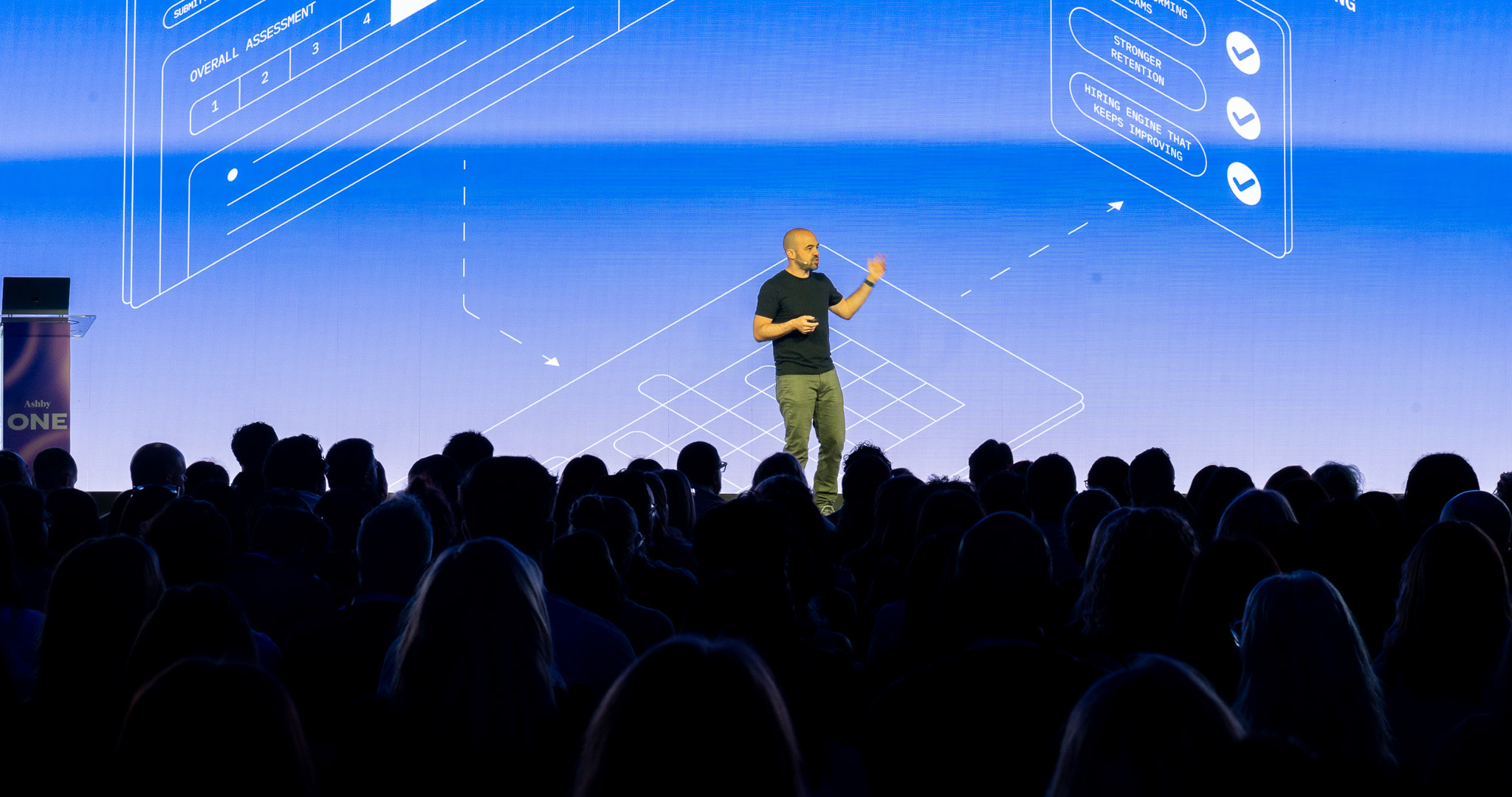
Ashby One Product Keynote - 2026 San Francisco
Ashby co-founders Benji Encz and Abhik Pramanik kick off Ashby One San Francisco with a look at our latest launches, the next generation of AI at Ashby, and where we're headed next. Highlights include the announcement of Ashby Assistant + Custom Agents, our upcoming AI Interviewer, and the People Workflows product built to handle post-hire workflows like onboarding.
View session
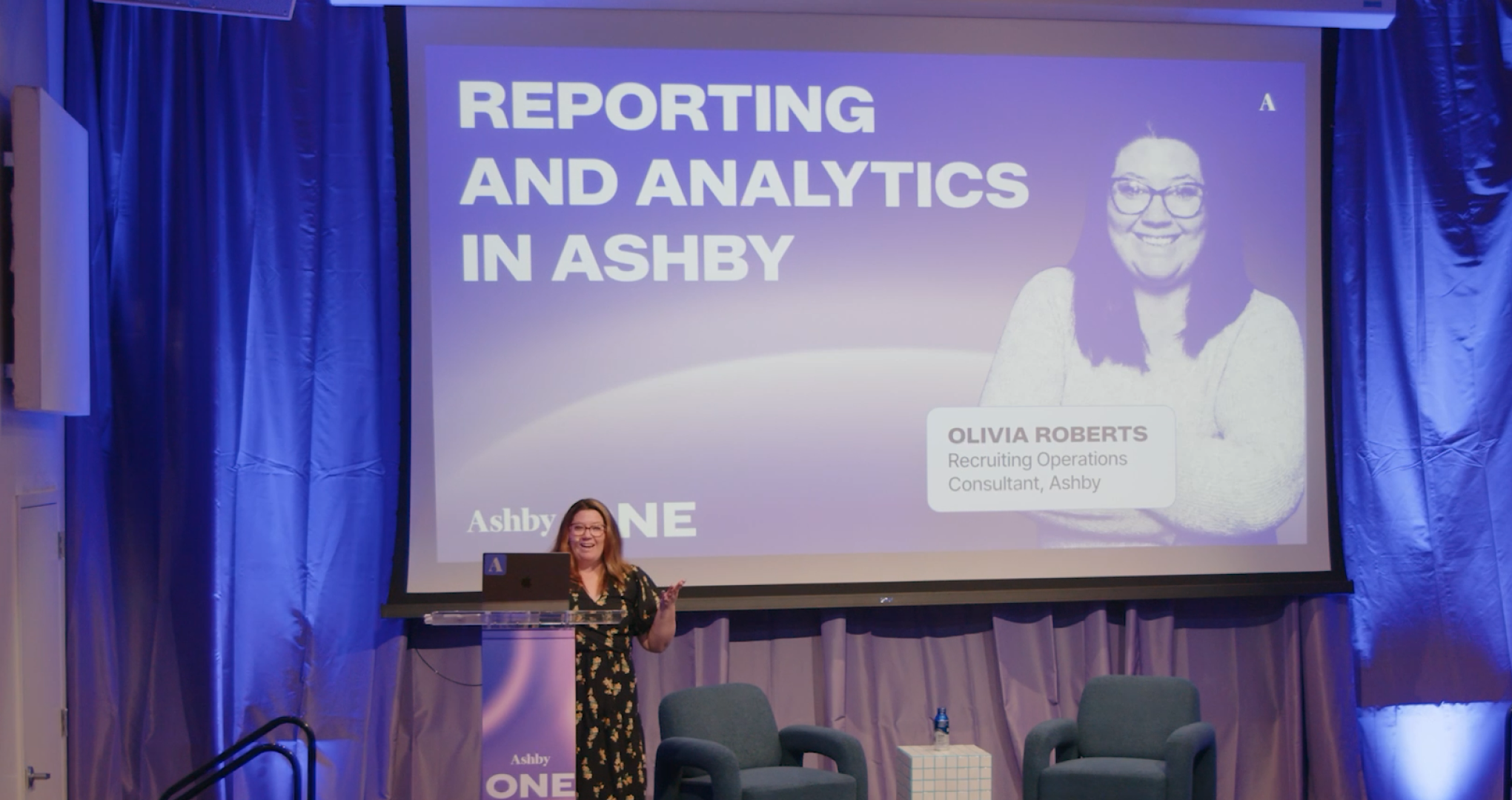
Reporting & Analytics in Ashby
Create dashboards and reports tailored to how your team hires. Track metrics like Quality of Hire, Funnel Velocity, and SLAs with calculated fields, and turn recruiting data into leadership-ready insights.
View session