Modern Recruiting Metrics
Data accessibility has changed massively over the past decade. Join RecOps experts Laura Li from OpenAI and Max Butler from Ashby as they walk through specific, real-time, and goal-oriented recruiting metrics every team should be tracking.
Speakers


Overview
- Reporting: Where to start
- Static Metrics
- Actionable Metrics
- Recruiting Data Storytelling and Narratives
- Dashboard Design for Different Stakeholders
- Recruiting Process Optimization Through Data
Transcript
Note: transcript is auto-generated, there may be typos.
[00:02:00] Max Butler: Cool. Alright, thanks Devin. There we go. Good. Um, awesome. Well, yes, as Devin said, I'm Max Butler. I'm a recruiting operations consultant here at Ashby. And I, although am only eight months into my role here at Ashby, I've spent the last nine years as a rec ops leader, rec ops person. And so a lot of my work is heavily focused.
Max Butler: A lot of our work is heavily focused on helping recruiting teams make sense of their data, turning messy, overwhelming dashboards into actionable insights. So in the next 40 minutes, we're going to cover a lot of ground, but we're gonna start with how you even approach your data. We'll talk about the evolution of static metrics to more actionable modern recruiting metrics.
Max Butler: We'll talk about how to put some narratives and storytelling with your data. And then we'll wrap it up here at the end with some tailored dashboards that, and we'll do this in real time that Laura and I had put together to, uh, bring this all together. So with that said, I'm gonna hand it off to Laura. I.
[00:03:00] Laura Li: Awesome. Thanks Max. Super excited to be here today. Uh, rejoining the Ashby team, as well as seeing some familiar and unfamiliar faces. It's amazing to see the recruiting operations community and the Ashby community continue to grow. So super grateful for y'all coming today. When I look back at some of the teams that I've worked with, when we start talking about analytics, the most common challenge we typically start with is where to get started.
[00:04:00] Laura Li: Whether you are building reports for the first time, collecting new data, or trying to uplevel your reporting sophistication, the hardest thing to do is figuring out what that first step is. There's just so many options. If you've had the pleasure to, if, if I've had the pleasure of working with you in the past and having these conversations, you'll know that I like to anchor all of this with a question of what is your overall goal?
Laura Li: Make it lofty, don't have your technology limitations, data limitations, or team limitations. Be a part of that. We know what we are building toward, and then we'll work back to some more feasible goals in the short term. So I invite you to think about, uh, to maybe think of this approachable one. Um, imagine you walk into your leadership meeting and you're able to very quickly say, here's what we're tracking, why it matters, and exactly what we need from you, even if that future seems pretty far away.
[00:05:00] Laura Li: It just takes one step, one question, one new data set you've collected and one messy report to get closer to that future, we just have to get started. Before you get started, though, even touching a spreadsheet, it's important to reflect. Why should data matter to you and your team specifically? Obviously, we know the data is helpful.
Laura Li: Stakeholders love data and data helps us make informed decisions, but get a little bit more personal than that. What question are you trying to answer with the data you're trying to get? What conversations are you going to enable and what other parts of the process will you unlock when you're able to provide more insightful data?
Laura Li: There isn't a single way to do data correctly, but there is a proper mindset, and that mindset is curiosity. So let's talk about how to move from, we don't know where to start to, we are ready to explore. So what do I mean when I say curiosity? I mean real curiosity, not vague interest. Um, that means it's not just an action or a reaction.
[00:06:00] Laura Li: It means we're really asking the deep questions. What is really behind this request? What are the motivators that is asking us to be polling this data or starting this data journey? What may be some external motivations that are also impacting that? What does the business care about right now and what do the priorities look like and how did we even get here?
Laura Li: What historical information do we have? Um, and then what assumptions exist? What metrics could possibly support or challenge those assumptions we have? I wanna quickly touch on assumptions because sometimes, especially when you don't have data available, um, anecdotal data and living lived experience is.
Laura Li: All you have, and those are really important. But when you're going into conversations, um, it's really difficult to drive action or influence change With stories alone, having tangible data helps you have a shared language with your stakeholders that may otherwise never touch recruiting data. So we really wanna make sure we are pairing lived experience with concrete data by using it as a gut check, but being open to what the data will eventually show us.
[00:07:00] Laura Li: Even if it challenges some of the assumptions that your team or even you have. So an example here is, let's say a department head asks for some top of funnel metrics and wants to understand our sourcing volume at the surface. That's actually a pretty easy report to pull, especially with tools like Ashby.
Laura Li: Um, so I could easily just give them a report of here's how many candidates we've sourced, but we haven't really asked the real question. We know what he's ask, they're asking for, but we don't know what they're actually asking. So we want to deep dive into that. Usually when I get one of these requests, there's an underlying belief that sourcing or candidate volume is what is holding us back from making a hire.
Laura Li: And that very well may be true, but if I only deliver that single report, we aren't exploring all the other options and avenues that got us to where we are today. So before rushing in to pulling that report, uh, we'll want to really ask ourselves what else can help us here? Sourcing activity capacity, hiring manager alignment, process delays.
[00:08:00] Laura Li: There's so many other things that we really wanna take into consideration before we jump into action. So when we think about being curious, that means providing and searching for clear context. Before building dashboards, you want to represent your team's experience. As well as your hiring manager's experience, while also remaining open to being challenged.
Laura Li: In order to do that, you're gonna dive into the data, even if it's messy, use it as a discovery tool and then again, validate slash compare to the quantit qualitative information that you have, and treat anecdotal data as a lens, not the full picture. Okay. Sometimes mindset and framework is just as, or maybe even more important than the reports and the tools you're utilizing.
[00:09:00] Laura Li: So make sure that you have a deep understanding, or at least are working toward a deep understanding of your team's current state culture and needs. As I mentioned before, uh, at this stage, data is just a tool for discovery, not yet a source of truth, so stay curious and remain open to what can unfold. So now we're curious.
Laura Li: What are we gonna do next? This is where we're gonna put concept to keyboard. The trick here is to start with what you have and know and also are easily aligned on. That could be a trend report or maybe a shared report that you have between hr, finance, um, and recruiting, or even that pesky manual tracker you've been trying to get rid of.
Laura Li: Those are things that are currently being utilized and referenced. So if you're able to pull from those and align and make sure to anchor on those, there's already gonna be a shared alignment when you're providing new tool, uh, new reports. When you're in the discovery phase, it's really good to pull as much data as you can for yourself, the data practitioner.
[00:10:00] Laura Li: Um, but even with that, we wanna build some guardrails. So when you're going through discovery, focus on one question you're trying to answer or a general area of focus that is the most relevant to clearly define what focus data you're looking for. You want to consider what you want and what you currently have, and then take a look at the priority action or answer that you're look or question that you're trying to answer, um, and tie that to a single data point, um, or action in the process that you would like to track.
Laura Li: A common mistake I see some folks make is they'll build this menu of reports and share it directly with recruiters, ta, uh, heads of talent, or even worse stakeholders. I. By providing these big dashboards super early without having a shared understanding of what it's showcasing and building a strong foundation, we will likely create more confusion than clarity.
[00:11:00] Laura Li: So it's really important to keep that to yourself and decide what is going to be worth sharing with the team and at what time. So meet your team where they are. You want to start small, build trust, and start with something that is feasible and easily aligned on. Um, by doing this, we're going to build credibility, um, and also show values of val, the value of these reports, which will get them hungrier and more excited for the additional metrics and, um, datas data that you'll be able to provide down the line.
Laura Li: Uh, max, I know you've worked with so many talent teams. Um, does this align with your experience?
Max Butler: Yeah, I'm like smiling as you're going through this because I wish more teams put that in practice than I often see. Um, in my role as a consultant and I plug into a company, what's more common is I'm working with, let's say a new head of talent or a new rec ops leader.
Max Butler: They're often overwhelmed. And then just say, just, just show me the data. Just like, give me all the numbers. Or they use that lovely overused phrase, we don't know what we don't know. And so, um, or what's even more dangerous is that they ask. Well, what are the other guys doing? Or can you just show me the d, the reports and the dashboards that they're doing over there?
[00:12:00] Max Butler: Just give that to me. And that's never a good place to start. And for me, uh, as a consultant, I wanna make sure that I'm guiding the conversation, having, like trying to hit that reset button and to get them back to their reality. Um. Because if you don't even know how many jobs you have that are actively open, then you don't need advanced reporting and like super dense dashboards.
Max Butler: So it's really important to what Laura said, this is like understand your reality, meet you and your team where they're at. And start small. Start with some of those basic numbers. Get some quick wins to give you a foundation to stand on, and then that way you can start to move into some more actionable reti, real time data.
Max Butler: Yeah.
Laura Li: Awesome. Well, hopefully after this we'll definitely see more of that. Um, but let's say you've already been doing that. You have a good foundation of the basics. They all understand how many hires you've made, what your offer acceptance rate is, what happens when you want to deliver on more complex asks.
[00:13:00] Laura Li: I think the principles still apply to that. So starting with the why, understanding what is the reason we're pulling this information to begin with. Identifying the focus area and the data that you're going to want to pull. Um, and then use what you have and know. The added complexity here is usually if it's complex, it means it's hard to pull and you don't have all the data you want.
Laura Li: So it's important to be transparent about where the data is today. If we think about an example, let's say you're trying to see the effectiveness of a new interview type. The best time to think about how will we display success in this is actually before you start. Um, if you have, if you were thinking about this beforehand, it'll be pretty easy to AB test.
Laura Li: You can change an interview title, make sure it's easy to identify that this is what the newer one is and this is the older one, and then pull reporting from there. But let's say you joined after the fact, or maybe we just really had to prioritize speed in this moment and we didn't have time to think about the data impacts of that.
[00:14:00] Laura Li: There's still a possible way to pull data on it. It will just be more directional than definitive, so you can use the launch date looking at interviews that happen before and after you launch these interviews. Or maybe there are interviewers that are specifically trained on that new interview and are more likely to have done those than others that who have not been trained yet.
Laura Li: There are always ways to find a proxy, although not perfect. It will provide you some directional data, which will keep your teams hungry to learn more. Um, again, as I mentioned, it's always important to label the data as such. So be honest. Let them know, here's what we have, here's where we want to be, and here's what we as a team need to do in order to get there.
Laura Li: I find that a lot of teams. Hesitate to do that because it may feel like we are saying we don't understand our data or we're not having great data practices. But for folks who really value data, they find this to build trust rather than degrade it. 'cause they know that you care about the accuracy of the data you're providing them and that they know you know how to get to that future state.
[00:15:00] Laura Li: So some of you're probably brainstorming what reports are feasible and agreeable at this point. And a great place to start is static metrics. And I'll pass it over to Max to talk about that.
Max Butler: Alright, thank you. So we're gonna start with some of those metrics that we all. Probably grew up in, in recruiting what we're gonna call static metrics.
Max Butler: So these are some of your classics, time to fill, offer acceptance rate, number of hires per month. Um, and they're easy to pull, should be fairly easy to pull, and they're widely known. And um, honestly, they're still useful at the right place in the right time, but they are just a piece to a very large puzzle.
Max Butler: So our goal is to understand where they fit in. When to use them and when to push further into some more me meaningful real-time metrics. So with that, here are some of your usual suspects, your time to fill your numbers of higher app volume, all that good stuff. And these are the metrics that a lot of teams start with, and a lot of teams start with these types of metrics and never really expand beyond.
[00:16:00] Max Butler: Why? Uh, there's a number of reasons why that happens is one, uh, they're very easy to benchmark. So whether that be internal benchmarks or external industry reports, fairly easy to benchmark. Um, they're referenced in probably like every vendor slide you get, or it's hard to open up LinkedIn and not get three, four posts in without someone talking about one of these metrics and the success or loss they had with it.
Max Butler: Um, and they're metrics that your leadership team probably already knows how to talk about. So. Our friends outside of recruiting, hiring managers and VPs quite familiar with these terms. Um, and so I wanna walk through these and a few others with a critical lens and talk about why these are helpful and what they may be missing.
Max Butler: So why do these types of metrics stick? Well, first they're familiar. Uh, they're widely known and they esto they, they establish that common baseline that. We'll give you kind of the comfort and that foundation again to talk that we talked about, to move into some more actionable, more some advanced modern recruiting.
[00:17:00] Max Butler: Um, take time to hire, for example. Uh, one, it's pretty self-explanatory, but two, if you're working with a new hiring manager, explaining time to hire is a hell. A lot easier than explaining will Ducey Hero Index. I mean, you have to be pretty advanced and like your shit together before you get into the Hero Index.
Max Butler: But if you don't have these basics figured out. Um, so they're very familiar with, uh. With the audience. Second, um, the historical, uh, they're really good for historical data and look back, uh, it's really easy to look back and see how your team or your company has performed quarter over quarter, year over year, which also does support your capacity planning.
[00:18:00] Max Butler: So they give you a really good, it's a good indicator to understand what your recruiting team is capable of. What they have done, what they can do. So when it comes to bandwidth and when it comes to capacity planning, these are a lot of the metrics that you'll pull together. And looking back, what has happened in previous months.
Max Butler: So while they are very helpful, um, and something that you should all know by heart, they are limited in providing insights into current performance, um, and understanding what you as a team need to improve. Um, I often use these types of metrics when I'm first meeting with a customer. Or maybe just jumping in to take a look at their account.
Max Butler: These are really good static, uh, audits that I'll use or spot check to just get a sense of the overall volume and speed that a company's dealing with. So I may look at their number of hires, maybe group that by department overlap the sheer application volume, just to know like what kind of, uh, what number of candidates they're dealing with.
[00:19:00] Max Butler: And then look at your time to hire month over month. And that will give me. Um, a really good understanding. It's a good health check as to how the company has been performing before we get into more detailed conversations on where they want to go from there. So here's the deal. If you wanna build a modern data informed recruiting function, then it's pretty important to understand where these types of metrics will fall short.
Max Butler: Um, here's what these metrics miss. They're, uh, retroactive. They are a backward looking, surface level type metric. And they only reflect what has happened. So they're not gonna offer you insights into how you got here or what levers that you need to pull to out, improve your outcomes. Um, they lack context.
Max Butler: They can be these high level aggregates. I bet a lot of you probably have a time to hire tile on your dashboard, or a report just has like a number 32 on it. And so, although the time to hire is, uh, maybe, you know, you're at 30 days and you think that's great, that's your goal, but. What, what's slowing us down?
[00:20:00] Max Butler: You know, who's moving too fast? At what point in the process are your candidates getting stuck? And again, it's time to hire. So what about all the people that didn't get hired? You know, what's the speed in that area? I don't know why I keep on picking on time to hire, I'm gonna move on to something else, but that's just what I keep coming back to.
Max Butler: Um, and then also they're not actionable, so, um, you can't coach or course correct based on number of applicants per hire. Right. Uh, that's gonna, you're gonna need more detailed stage specific data. To identify any inefficiencies in your recruiting process. So one of the most dangerous things about 'EM too is that they can reinforce assumptions and drive misalignment.
Max Butler: Um, they validate incomplete narratives, which we'll talk about here in a little bit. But someone might have the assumption or assume that there's fewer hires happening month over month, and that is due. To poor sourcing efforts when in reality it's probably that you have an overburdened team of interviewers that are, uh, have a record, high offer decline rate, or you're constantly having to reschedule.
[00:21:00] Max Butler: And so there's a lot of things that happen that can cause fewer hires per month. But if someone has an assumption or some type of narrative around it. Static metrics can validate that, which can be dangerous. And then lastly, these metrics, they ignore experience and quality and something that we have been talking about a lot in the past few years, but you're not gonna understand how your candidates felt about the process.
Max Butler: Based off of some of these numbers, you're not gonna understand how the hiring manager felt with the overall recruiting process and then quality. You're not. Able to tell if the person or the people you hired for the role are actually successful or productive in that role. So as I was putting to this together, um, I kept thinking about the many years I put together QS or annual business reviews for different departments and various recruiting teams.
Max Butler: And, um, when we finally got everyone together to do a, you know, recruiting QBR, let's say it's like a Q1 QQBR. And when we got together, we were like, wind's a key word because I don't know about you. Every time we did like Q1, we wouldn't find ourselves until like May or June getting the right people into the same place or on the same zoom to actually talk about what has happened.
[00:22:00] Max Butler: And it took some time for me to realize like, this is ineffective. We sit down and we talk about what we did. And the types of metrics and the timing wasn't working for us because it was already too late to shape our Q2 strategy or the remainder of the year. So didn't make a lot of sense to sit down and talk about what went wrong or what went right if it's not gonna influence the decisions that we're gonna make today.
Max Butler: So, um. So, yeah, it, it's, uh, if you wanna uplevel your recruiting team, you need to, um, not only just live and breathe through static recruiting metrics, but you also need to apply some of these more modern, some of these more real time metrics, um, that you can layer with that. So. I'm sure you've probably had some experience with this in your past.
[00:23:00] Max Butler: Uh, anything you want to add to that?
Laura Li: Yeah, I mean, I am, I've built as many QBR as maybe a little bit less. You've definitely been in the game a little bit longer than I have, but the QBR are a risk if we are only presenting these static metrics once a quarter, that's a lot of time in between quarters.
Laura Li: Well, I guess it's one quarter, but there's a lot of time where they aren't getting provided any metrics at all. So we are leaving a lot of room for interpretation, for things to be changing. And if they're just waiting for these metrics alone, these will be the only ones that they're looking to track. Um, so when we do move into a space where, hey, we want to build you dynamic dashboards that are reporting real time, a lot of these metrics don't work very well over a smaller period of time because there's too much volatility and you're not actually gonna get much insights out of it.
Laura Li: But it's difficult to explain that to them if they think that this is all that there is. So that's where actionable metrics will come in.
[00:24:00] Laura Li: Okay. Actual metrics, why are these important? As all of you know, we have been working and living in unprecedented times. Change is constant. Uh, whether that's in the world, in our industries, in our companies, and on our teams, that means retrospectives. Looking back at what has happened before isn't really gonna cut it anymore.
Laura Li: We really need to make sure that the data we have allows us to respond in real time and not just explain how we got here, although that is really important. Having these sort of metrics are going to enable decision making and not just reporting for reporting's sake. So let's dig into what makes a me, uh, metric actionable and how to identify the ones that matter for your team.
Laura Li: Actionable metrics are not nice to know. Their need to act. Although it, if provided without proper context or intent, they can be, um, nice to know as well. Um, some examples of ones, uh, that we have listed up here are pass through rate, candidate experience, interview hours per hire, and these show current state performance, not just outcomes.
[00:25:00] Laura Li: As with all metrics, um, we wanna caution that you should never rely on just one report alone. That's not going to give you the full story. So you wanna make sure that you're providing enough context for folks. What is the data quality? Why does it matter? And what are we doing to ensure that the data going into these reports are clean?
Laura Li: Um, make sure that you have a clear question in mind and make sure that the, that people understand the process to help them interpret these reports. So let's go back to that example from before department Head asked for sourcing volume. Um, the assumption here is, again, we lack candidates and that's what's stopping us from making our hires.
Laura Li: The reality is we can go deeper. So something that I would show, or the reports that I would likely show are talent, activity by stage and focus on what is actually happening per stage and use this as a vehicle for education, not only to highlight the work that your team is doing, but also so they understand what else is impacting candidate volume or candidate success.
[00:26:00] Laura Li: Um, pass through rates. Those, uh, making sure that we can highlight, uh, bottlenecks, uh, really quickly. Um, hiring manager review conversion so we can quantify hiring manager alignment, um, and a slew of other ones. Whatever would be most relevant to you all. So rejection, reason, analysis, time and process by source.
Laura Li: Interview hours per hire. These reports might seem very common and maybe already utilized. You're like, oh, like what's so modern about these? And realistically, what makes them modern is how we utilize them. They're going to be most powerful when we are using them as diagnostic tools. Um, that will prompt action, expiration and refinement.
[00:27:00] Laura Li: So we ensure that it's not ending the conversation, it's guiding it. Um, when we ensure that we are using these as diagnostic tools, we can then have more targeted reporting that aligns closer to your team's specific goals and the things that you've identified using these, um, using these diagnostic reports.
Laura Li: So to reiterate, actual metrics are specific part, uh, real time and goal oriented. Uh, these metrics allow for real-time course correction and they support smaller, smarter decisions across the business, not just in talent. Education, again, is going to be essential. These metrics matter a lot to our partners, so we really want to take advantage of that and use that as a way to not only tell them how we're doing, but to also educate them on how we're doing it.
Laura Li: It. Um, when we think about how we can innovate more within reporting, what's gonna be really important is that we have a foundation of understanding of recruiting metrics. So then we can free up more space for us as recruiting operations and data pro, uh, practitioners to go into more uncharted territory when it comes to reporting to answer those more complex questions that maybe we haven't even asked yet.
[00:28:00] Laura Li: Because the day-to-day is solved by the foundational reporting that you have built and the education that comes along with it. Um, so we really want to open up space for innovation, build trust early. It'll help you earn the space to expand scope and strategy, um, and ensure that, um, the day-to-day questions are being answered.
Laura Li: What is going to be paramount to this future state of more advanced reporting is recruiting operations practitioners like yourself, understanding not only the benefits of these actual metrics and others, but also the importance of data storytelling and narratives. And I'll pass it over to Max to talk a little about that.
Max Butler: Thank you. Yeah, it's, it's super important, whether it be one of those. An old school metric, maybe it's a static metric or more actionable modern metric like this. Um, one report by itself highlights a problem or it is a clue. But when you start pairing reports together and when you start to, uh, yeah, when you start to put these reports together, you start to get a much clearer picture.
Max Butler: So think of it this way, a single data point's a clue, and a set of reports is a narrative. And so. That's where the power of storytelling and data narratives comes in. So we've talked a lot about metrics, what to track, why to track it. But data alone does not drive action. We, what actually will move the needle is your ability to translate that data into a narrative that resonates with your stakeholders.
[00:29:00] Max Butler: So that's where data narratives come in. Alright. All right. Context is everything. Uh, you can have every dashboard in the world, every single report that you can think of, but without tying that back to the business objective or your team goals, it's just noise. So your data should be an understanding of what's working and what's not.
Max Butler: This is gonna help you go. The context behind the dashboard or a set of reports is gonna help you go from surface level metrics to understanding the why. Um, you might see, again, a high number of interviews yields, you know, one higher and this number continues to grow. And without context, that's just a number.
Max Butler: But with context, you start to realize that's due to a low pass rates or a high number of candidates rejecting you late in the process due to a negative experience. And so, without making an assumption of why does it take this many hires. With this many interviews to get a hire, but when you start to match that up with other data points, starts to really tell a story.
[00:30:00] Max Butler: Your data should also be a watch tower to catch issues as they start to occur. If you are tuning into the keynote. Earlier you saw someone talk about this being a watch tower and being able to see over the forest, and that's exactly what, uh, your reports and your dashboards should do. So think of a contextualized, uh, contextualized data as a early warning radar to, uh, instead of waiting for those QBR to identify, um, that our pipeline was a hundred percent white male, um, then you can spot some of these inefficiencies in real time and address them as they are starting to grow.
Max Butler: Um, this is gonna give you a proactive stance and address problems while they're still small, not once they've already started to impact your overall hiring. And lastly, your data should be that foundation to build credibility. Um, it shows that you're not just reporting for the sake of it, but you're proving that you understand what matters to the team.
[00:31:00] Max Butler: You're proving that you understand what's important to the rest of the business. And when you tie recruiting metrics back to Team Cole, back to your team goals, you're then seen as a partner, not just a service function. And I feel like my entire career people have been saying, how can we get recruiting away from being that service function or paper pushers and be more proactive advisors, strategic thought partners.
Max Butler: This is one of those ways that you're gonna be able to do that. Um, it's also gonna help you shift the conversation with others instead of, uh, what went wrong or what happened last quarter to what do we need to adjust this week? Where do we need to shift our focus today? So how do you do that? Well, I've learned that people that are able to put the right reports with the right messaging in the right place is a bit of an art.
Max Butler: And so a well contextualized dashboard, having the right metrics in place is gonna not only show what has happened, but it's gonna give you the insight and the confidence to act. And in doing so, you're going to accelerate credibility. So I just talked about this a bit, but when your data is clear.
[00:32:00] Max Butler: Relevant and tied directly back to the business, then you're gonna start to gain trust. Stakeholders don't have to ask questions, um, of like, where are these numbers coming from, or what do they mean? So take like the recruiting planner, for example, that Kelsey showed off this morning. When you're able to take a plan and lay it out, group it by department that is gonna allow the VP or let the stakeholder come in and look at it and give them the answers of.
Max Butler: Are they on track or are they off track? A question that we get a lot, but if you're able to, instead of showing that you've made 71 hires year to date, but if you can show how many hires each department has made month over month and who is falling behind and who is well on what on their way, there's no conversation needed.
[00:33:00] Max Butler: It's very clear there. Um, you're gonna drive improvement. By doing these, taking these steps, you're gonna drive improvement. So again, spot inefficiencies in real time. And this might be, um. You overpaid for a job board, um, no names, but you, maybe you spent way too much money and the pass through rate is insanely low.
Max Butler: And the ROI, you can see this happen in real time or maybe it is that you see a group of interviewers or an interviewer that's constantly ignoring feedback and your feedback completion percentages insanely. Low for this group. I'm sure none of you have ever dealt with low feedback completion scores, but these are things that you can spot in real time and you start to drive improvements while this is happening.
Max Butler: So you're not waiting until later to say, well, how did we get here? And then lastly, that is gonna give you that ability to proactively respond to what's happening in your business. So you're gonna shift that recruiting from that reactive support function. To having a team of talent advisors, uh, maybe even your rec ops, being empowered to be thought leaders and partners to the business as you're able to quickly identify some of these inefficiencies, then make those small, timely course corrections that's gonna prevent bigger problems before they really start to occur.
[00:34:00] Max Butler: So how do you communicate these insights in a way that actually lands, and that's where storytelling comes in. Um, again, data without narrative is just noise. It's the story that helps people understand what's happening, why it matters, and what we're gonna do from there. So the story, it should reflect what, uh, your story should reflect what the business is trying to achieve.
Max Butler: I know I've said that a lot, but I spend a lot of time with customers saying what they don't know where to start. It's. Well, what's important to the business? Um, and, and anchor on that. And oftentimes it's, well, we're trying to speed up, we're trying to reduce various time-based metrics, or we're trying to improve diversity, or maybe we're launching.
[00:35:00] Max Butler: An office in X region or we're gonna approach hiring by hubs, these things that are important to the business, and then starting to build reports off of that and kind of tell that story that we're working with the business and their overall objectives, um, is key. And so next. Think about your audience.
Max Butler: What questions do they care about? What decisions, um, are they trying to make? Laura touched on it by not grabbing a whole bunch of reports and throwing it at a recruiter or more dangerously throwing a, a stakeholder. But understand your audience and understand what kind of questions, uh, they're trying to answer.
[00:36:00] Max Butler: And then use these modern, uh, use these modern actual metrics to connect the dots. Show if they're on track, provide context behind the numbers. Don't just throw data at people. Show them, um, what they're looking at and help them understand the why. So have you had any success or wins in your career by telling a story with data?
Laura Li: I'd like to hope I've had a few. Um, but honestly, listening to you talk kind of brings me back more to the beginning of my career when I first started diving into data and moving into recruiting operations. Um, I didn't have a lot of guidance, so when I got requests for reporting, I viewed it really transactionally and not intentionally.
Laura Li: Um, they would be sometimes really, they would be always very specific and sometimes really convoluted and complex. Like, I wanna see performance of this interviewer when they're partnered with this person or with this specific team, or during this season of the, of the year. Um, and those things were really difficult to pull and I found a lot of joy in figuring it out.
Laura Li: But I also spent. A lot of time doing that. Um, so when I delivered the report, most of the time it was met with additional confusion, or it was looked at for maybe five minutes and then we never talked about it ever again. Um, even though there was a lot of fulfillment in making, figuring out that puzzle, I didn't really answer the question they were asking.
[00:37:00] Laura Li: I was a answering their hunch in the moment. So if I could go back in time, I think really thinking about these requests as a small part of a larger question and answering, working toward building dashboards and reports that can help us answer that question today and in the future.
Max Butler: Yeah, I love that.
Max Butler: Well, we've covered the evolution of static metrics to actual ones. Um, how to frame them in the context of a story. So let's take it a step further and let's, uh, take a look at what these actually look like in practice because the real magic happens when metrics are tailored to your business and your OKRs or goals.
Max Butler: Alright, let's walk through a few, uh, example dashboards that we've put together. So we're gonna shift the focus something a little bit more interesting.
Max Butler: That was easy. Um, all right. I'm actually gonna. Act like, uh, can everyone see this all right? No. Do you want me to, we can make it a, we can make it a little bigger 'cause
[00:38:00] Max Butler: All right. So I actually didn't tee this up, do you It? Yeah,
Laura Li: go ahead.
Max Butler: So you should know what you're looking at. Um, can I actually go back on this slide?
Max Butler: All right, so I was too eager to jump in and show you the dashboard, but I should explain why this dashboard's put together the way it is. Um, yeah, context. All right, so this is gonna be through the lens of a ahead of talent that needs to understand are we on track or are we not? Uh, where do I need to apply pressure?
Max Butler: Strategically, they're looking at things like your headcount plan. Um. Uh, they're looking at their overall like team performance, um, various benchmarks, but tactically they need to understand where some of the bottlenecks exist. And they also need to understand if they are effectively interviewing, that's gonna set them up to yield some hires.
[00:39:00] Max Butler: So in doing that, you're going to need a set of reports very similar to a progress to hiring plan NPS pass through activity by stage time to fill interviews. To hire and, uh, yeah, that's gonna be able to connect both that strategy and the tactical work, bring it into one place that they can quickly open up look at.
Max Butler: So I already gave you a sneak peek, but let's take a look at the dashboard here. Okay. You wanna switch so I can Uh, yeah. Big switch through. So first front and center, what's really important is that when I look at dashboards, it's like, oh yeah, I'm looking at it. But there's not a lot of context. But having your KPIs, your team goals, your overall business objectives, whatever is key, have it set right there.
Max Butler: So it should be pretty easy to know that we're looking to make 30 hires hiring manager to offer ratios, a KPI that we set for the team to three to one. Again, a lot of this is based off of historic activity, think static metrics, as well as what is our, uh, benchmark internally. And so we have NPS for both hiring managers and candidates and our time-based metrics.
Max Butler: So right off the bat, we need to hire 30 people and we are at 25 looking to blow that goal outta the water, which is really good. But I also am noticing that the hiring manager to offer ratio is a little bit higher than we planned on, and so quickly here to pass the rate. Lovely because you kill a few birds with a stone that I can see how many candidates are moving through the process and which channels they're moving through.
[00:40:00] Max Butler: But yeah, there is a little bit of a bottleneck and something going on with the hiring manager screen, which plays into our overall hiring manager screen to offer speed though. We have a goal of 69 days to fill our jobs, and we're sitting right around 66, so it's not hurting us too much because we're.
Max Butler: Cutting in and out. Uh, it's not hurting us too much because we're still filling our jobs under that estimated time. So looking at what's happening today, we have a quick snapshot of overall interview activity. It looks like we do have a good number of interviews taking place across the right departments at late stages, which is nice, but also looking at that time to time to fill, keeping a close eye on it.
[00:41:00] Max Butler: I can quickly see. Where are my candidates getting stuck in the process? And so, um, again, context and being able to tell a story. Everyone that's, anyone that's looking at this dashboard can understand that we have interviewed per hire in the median time and process is a key performance indicator. And we're looking to make sure that we're doing this within 30 days and candidates aren't staying in later stages any longer than eight days.
Max Butler: So there are no real bottlenecks that exist. Maybe infrastructure engineer, um, and then interviews per hire trying to stay under 30 interviews. Product pretty high. Which by the way, I don't know why product and engineering is like always the problem child when it comes to like recruiting data. But yeah,
Laura Li: even in dummy data.
Max Butler: Oh, any kind of data. Yeah. And so anyways, no surprise, just a little bit above, but at the very end, how does that come together? How are people feeling about the process? We just rolled out hiring manager experience surveys in this demo account, and so we're being able to capture. Are the hiring managers happy with the way the team's performed and the candidates that they hired?
Max Butler: So far, so good looking. And then on the candidate side, how are we doing over there? Here's our NPS. We just roll these out in December. Um, we're aiming for NPS of 50. Um, not looking so good, but, uh, we now know at a quick glance, uh, what is happening strategically on the recruiting front. What are the recruiters, sorry, what is the recruiting team doing and where do I need to apply pressure to increase performance today before they become bigger problems down the road?
[00:42:00] Max Butler: So this is how I would approach it as a head of talent if this scenario was set up. But a clean dashboard looked at on Monday morning gives me all the information and data I need to take action.
Laura Li: Awesome. Well, let's shift to another persona. Equally as important is the head of a department. Um, so a lot of the things that a talent leader cares about, a department head also cares about.
Laura Li: They're both really busy. They wanna see the most important metrics to them quickly. Um, and they don't wanna spend their time scrolling, trying to figure out the answers or the answers to the questions that their stakeholders, their hiring managers, their CEO and other leaders are going to be asking them.
[00:43:00] Laura Li: There are gonna be two key differences when I think about a head of a department versus the head of talent, and those are understand the under their understanding of recruiting data and the scope of their responsibility. Let's talk a little bit about how they understand recruiting data. Most of our stakeholders and cross-functional partners have their own set of data, and a lot of times it's a lot richer than the recruiting data we have access to due to regulations around how we can collect them.
Laura Li: And also just what is humanly possible to collect from a candidate versus let's say a customer. So when you're talking to the head of product, head of sales, head of engineering. They're coming through the lens of the data that they know. So it is important for us to utilize our dashboards to show them the difference so they can truly understand what these metrics are showing.
Laura Li: Um, the most common questions, uh, that they tend to focus on are around their headcount. So how close are we to hitting goal? What has been allocated, what has been filled? Um, understanding of funnel visibility, where everyone is, where do we need more candidates, um, and what the funnel pi, the pipeline health looks like, just overall.
[00:44:00] Laura Li: Um, and then interviewer performance and general bottlenecks. They're gonna ask you a variety of questions. These are just some examples of the ones that we tend to hear, but the primary goal is going to be they wanna understand and have confidence that their hiring goals will be met, and if there's any possibility that it won't be met.
Laura Li: They want to know what those blockers are so they can push forward action, whether that is through the recruiting team that is supporting them or their team. Um, again, we wanna make sure we're providing clear contextual reporting without overwhelming, um, and framing and alignment should be delivered with these dashboards as well.
[00:45:00] Laura Li: So let's walk through a sample dashboard of, um, one that we would provide to a head of a department. Amazing. Okay, so we built this dashboard for a VP of engineering similar to the head of talent. You're going to see that we have all of our goals listed up top. We really wanna make sure to remind everyone what we are focusing on.
Laura Li: It's really easy in a day-to-day when there's something urgent that comes up that is not something that our goal is focused on to dive deep into a rabbit hole. This gives us an opportunity to anchor them on what's important. Then, right next to it, we're gonna have those answers to the questions that they typically get.
Laura Li: How many open jobs do you have? How many hires? How many people are on offer? And then next to that is going to be candidate NPS score. But this is just because that's something that is within their goals. You just wanna make sure whatever's up top is the most relevant and what they'll need to answer to.
Laura Li: Not only do they wanna know what's happening right now and what has happened, they also want to know what is going to happen in the future. So we have a projection report here to showcase what they're forecasted to hire. Then when we think about scope of responsibility, hiring managers are going to be within their squarely, within their scope of responsibility.
[00:46:00] Laura Li: They wanna make sure that they feel that their hiring managers are getting the quality of support that they need. Um, and they also wanna hold them accountable if there's anything that we need to ask them to do. Remember providing context. So using these little text boxes is gonna help you provide that context without having to be sitting next to them every day voicing over what it is.
Laura Li: Then we want to also be able to support any follow up questions that they have. Um, you know, they will always have want to understand the details that lie within. So including some interview activity reports, scheduled interview activity, and then further down we have passthrough rate by hiring manager.
Laura Li: Again, back to that scope of responsibility. Um, so that's just a sample report, uh, sample dashboard that we would provide for, um, a head of engineering. Um, I know we're about at time, so we'll quickly run through the wrap up. Uh. Okay. The overall message we really wanna send is metrics are most effective when they're part of a story, and that's tailored, contextual, and actionable data doesn't need to be perfect to be actionable.
Laura Li: Just get started and move toward that future state. The most effective metrics, again, are used, shared part of a story and relevant. So don't wait for it to be perfect. Just make sure it's useful to your partners. Modern recruiting metrics are as much about the mindset as it is about the methodology, and we really wanna prioritize the human side of data so we lead to more meaningful narratives.
[00:47:00] Laura Li: So don't get lost in pulling the, uh, in what you're pulling. Invest in the why it matters.
Max Butler: Yeah, keep building. Keep asking why. And remember, your data matters because you give it meaning. And uh, yeah. With that said, thank you so much for spending time with us today. We hope that you walk out of here with some type of metrics that you can start applying immediately.
Max Butler: Thank you.
Key Takeaways
- Approach recruiting data with genuine curiosity and deep questioning to uncover actionable insights beyond surface-level requests
- Understand limitations of traditional metrics like time-to-hire and offer acceptance rate while transitioning to real-time diagnostic metrics like Quality of Hire
- Translate recruiting data into compelling narratives that resonate with stakeholders and drive decision-making
- Build trust and credibility through transparent, contextualized reporting that meets different audience needs
- Create role-specific dashboards for heads of talent and department leaders that provide actionable insights at a glance
- Use metrics as early warning systems to identify and address inefficiencies before they impact hiring outcomes
- Leverage data narratives to elevate recruiting from a service function to a strategic business partner
Recommended Sessions
Running RecOps as a System
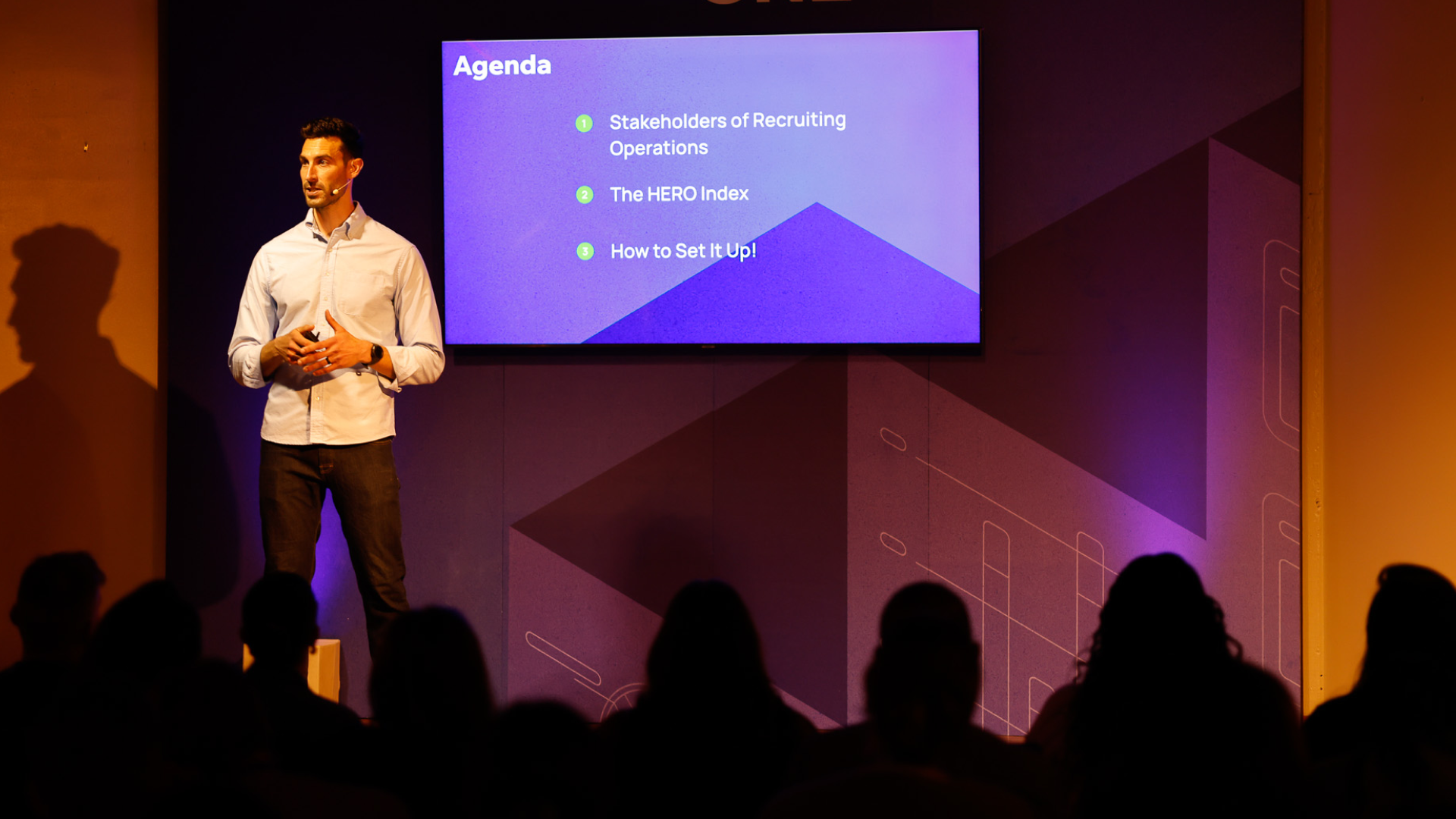
Will Ducey, Head of Recruiting Ops at Ashby, introduces the HERO Index framework for aligning recruiting metrics with stakeholder needs. Learn how to prove the strategic value of TA with evergreen metrics that drive clarity, impact, and continuous improvement.
View session
Measuring Talent Density with Quality of Hire
Join VP of Recruiting Laura Barnes as she walks through how Flock Safety went from manual tracking to a simple, automated process for measuring and actioning Quality of Hire data.
View session